
The Punjab Govt Daily Wage Increase 2025–2026 announcement has brought a wave of relief for thousands of hardworking daily wage earners across the province. In a move aimed at supporting low-income workers and stabilizing household incomes amid rising inflation, the Punjab Government has officially approved a major increase in the daily wage rate.
This bold decision by Chief Minister Maryam Nawaz Sharif marks one of the highest wage revisions in recent years. It reflects the provincial government’s firm commitment to ensure social equity and provide fair compensation to those who form the backbone of Punjab’s labor market from construction sites to municipal services.
According to officials, the new wage structure will take effect from November 2025, benefiting both government-contracted and private-sector daily workers. Let’s take a detailed look at the new pay rates, implementation plan, and the long-term impact this reform will have on workers and the economy.
Key Highlights
| Key Highlights | Details |
|---|---|
| Announcement | Punjab Government has announced a major increase in daily wages for 2025–2026. |
| Effective Date | Implementation begins from November 2025 across the province. |
| Beneficiaries | Daily wage and contract-based workers in public and private sectors. |
| Previous Wage Rate | Rs. 1,320 per day for unskilled labourers (2024 rate). |
| New Wage Rate | Rs. 1,600 per day, marking a Rs. 280 increase. |
| Monthly Impact | Approx. Rs. 48,000–50,000/month depending on attendance. |
| Percentage Increase | Nearly 21% rise — one of the highest wage hikes in Punjab’s history. |
| Objective | Reduce inflation pressure and ensure fair pay for low-income workers. |
| Departments Covered | Construction, municipal, cleaning, agriculture, transport, and others. |
| Chief Minister’s Statement | Maryam Nawaz Sharif emphasized “economic equality and dignity for workers.” |
| Enforcement | Labour Department to monitor compliance and employer reporting. |
| Future Plan | Minimum wage policy review based on inflation and cost-of-living data. |
Punjab Govt Daily Wage Increase 2025–2026: Full Announcement
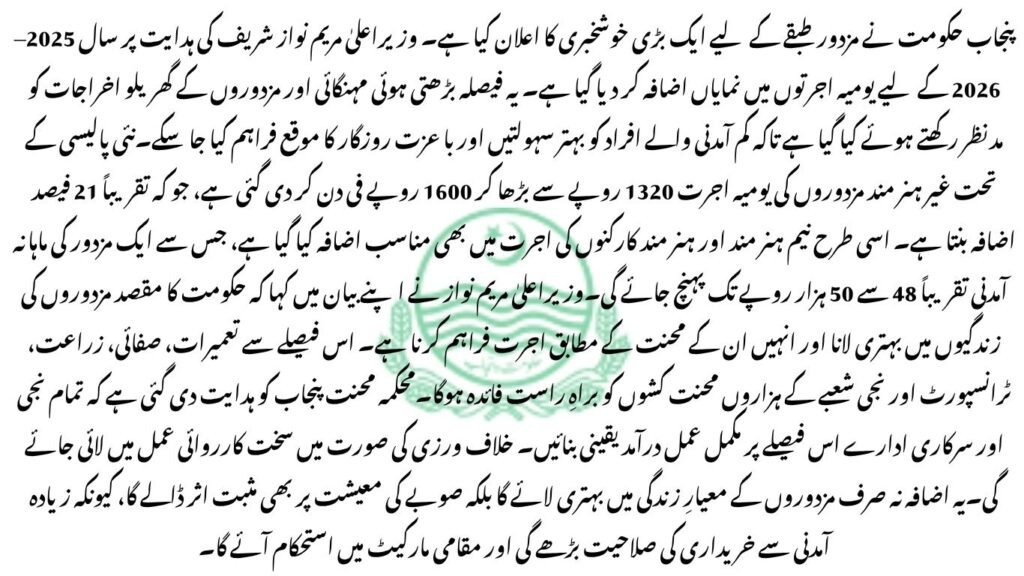
The Punjab Government has officially revised its daily wage policy for 2025–2026 to ensure that no worker is underpaid for their efforts. The new daily wage rate of Rs. 1,600 replaces the previous rate of Rs. 1,320 a move expected to immediately uplift thousands of families who depend solely on daily labour for survival.
“Every worker deserves a fair wage that matches their hard work and today’s economic reality,” said CM Maryam Nawaz while announcing the decision in Lahore.
The notification was issued by the Punjab Labour and Human Resource Department, directing all departments and private institutions to comply. Employers are now legally bound to pay workers according to the revised rate from November 2025 onward.
Old vs New Wage Rate Comparison
| Category | 2024 Wage Rate (Per Day) | 2025–2026 New Wage Rate (Per Day) | Increase (Rs.) | % Growth |
|---|---|---|---|---|
| Unskilled Workers | Rs. 1,320 | Rs. 1,600 | Rs. 280 | 21% |
| Semi-Skilled Workers | Rs. 1,480 | Rs. 1,760 | Rs. 280 | 18.9% |
| Skilled Workers | Rs. 1,650 | Rs. 1,950 | Rs. 300 | 18.1% |
This adjustment ensures parity across all levels of work — from daily labourers to machine operators and skilled technicians.
Why This Wage Hike Matters
The Punjab Govt Daily Wage Increase 2025–2026 isn’t just a policy shift — it’s a lifeline for thousands of workers struggling to keep up with rising costs.
Major Reasons Behind the Decision:
- Inflation control: Living costs have surged over 20% in key sectors like food and transport.
- Poverty reduction: The new rate helps bridge income inequality.
- Economic stimulus: Higher wages increase purchasing power and boost market activity.
- Social protection: Ensures stability for families relying on single incomes.
“This initiative is part of a broader effort to ensure no worker in Punjab lives below the poverty line,” a Labour Department spokesperson confirmed.
Sectors That Will Benefit Most
The new wage policy applies across all registered and semi-registered sectors.
Beneficiary sectors include:
- Construction and infrastructure projects
- Sanitation and cleaning departments
- Agricultural and field labour
- Public health and maintenance
- Transport and logistics
- Private manufacturing units
Private companies operating under contract with government departments will also be required to adopt the revised wage standards.
Government’s Monitoring and Enforcement Plan
To ensure transparency and compliance, the Punjab Government has launched a provincial wage monitoring system.
Key enforcement measures include:
- Surprise inspections by Labour Department officers
- Heavy fines for non-compliant employers
- Online wage complaint portal for workers
- Bi-annual wage adjustment based on inflation trends
CM Maryam Nawaz also hinted at forming a “Workers Welfare Committee” to address labour grievances and review future adjustments.
Public and Industry Reaction
The decision has been widely welcomed by the working class and labour unions.
Workers’ Reactions:
- “Finally, our hard work is being valued,” said one construction worker in Faisalabad.
- Many daily wage earners believe the increase will help them manage rent and utility expenses better.
Employers’ Views:
- Some private business owners expressed concern about increased operational costs, but acknowledged the need for fair compensation.
Economists’ Take:
- Experts say this move will enhance consumer demand, driving local market growth.
- Economists also expect the policy to reduce worker migration to other provinces or countries.
Economic Impact of the New Wage Policy
Punjab’s economy, which relies heavily on its workforce in agriculture, construction, and manufacturing, is expected to experience a positive ripple effect from this wage increase.
Expected benefits include:
- Boost in local spending and retail growth
- Improved productivity and worker morale
- Lower turnover in private industries
- Better standard of living for low-income families
By increasing disposable income, the government also expects indirect tax revenues to rise, strengthening fiscal stability.
Conclusion
The Punjab Govt Daily Wage Increase 2025–2026 stands as a milestone decision aimed at restoring fairness and dignity in the labour market. By raising wages, the government not only uplifts workers but also strengthens the province’s overall economic fabric. This initiative is a clear message: Punjab values its workers and their contribution to the province’s progress. As new wage rates take effect, thousands of families will finally breathe a sigh of relief stepping into 2026 with renewed hope, stability, and financial confidence.
FAQs – Punjab Govt Daily Wage Increase 2025–2026
1. What is the new daily wage rate in Punjab 2025–2026?
The new daily wage is Rs. 1,600 per day for unskilled workers.
2. When will the new wage rates take effect?
The revised wages will be implemented from November 2025.
3. What was the previous daily wage rate?
The old daily wage was Rs. 1,320 per day.
4. How much increase has been approved?
The Punjab Government approved an increase of Rs. 280 per day.
5. What is the percentage increase in wages?
There is an average 21% rise in daily wages compared to 2024.
6. Who announced the wage increase?
Chief Minister Maryam Nawaz Sharif officially announced the increase.
7. Which workers will benefit from the new wage rates?
Daily wage and contract-based workers in both public and private sectors will benefit.
8. Will private companies also have to pay the new wages?
Yes, all registered private employers must follow the new wage law.
9. Which department will enforce the wage increase?
The Punjab Labour and Human Resource Department will monitor enforcement.
10. What is the new monthly income estimate for workers?
Workers can now earn around Rs. 48,000–50,000 per month.
11. Why did the government raise daily wages?
To reduce inflation pressure and improve living standards for low-income families.
12. Will skilled workers also get a raise?
Yes, skilled and semi-skilled workers will also receive proportional increases.
13. What happens if employers don’t follow the new wage policy?
Non-compliant employers will face penalties and legal action.
14. Does this apply to all districts of Punjab?
Yes, the policy applies province-wide across all districts.
15. Will there be future wage adjustments?
Yes, the government plans to review wages bi-annually based on inflation and cost of living.