
The Higher Education Commission (HEC) of Pakistan has officially introduced the HEC New Computer Science Syllabus 2025, marking a major milestone in the country’s academic landscape. This newly revised curriculum is designed to bridge the gap between academic learning and the rapidly evolving tech industry.
HEC’s aim behind this reform is to equip students with modern computing skills, promote industry alignment, and prepare graduates for global digital competition. The HEC revised computer science curriculum brings significant updates across core subjects, practical labs, and specialization tracks.
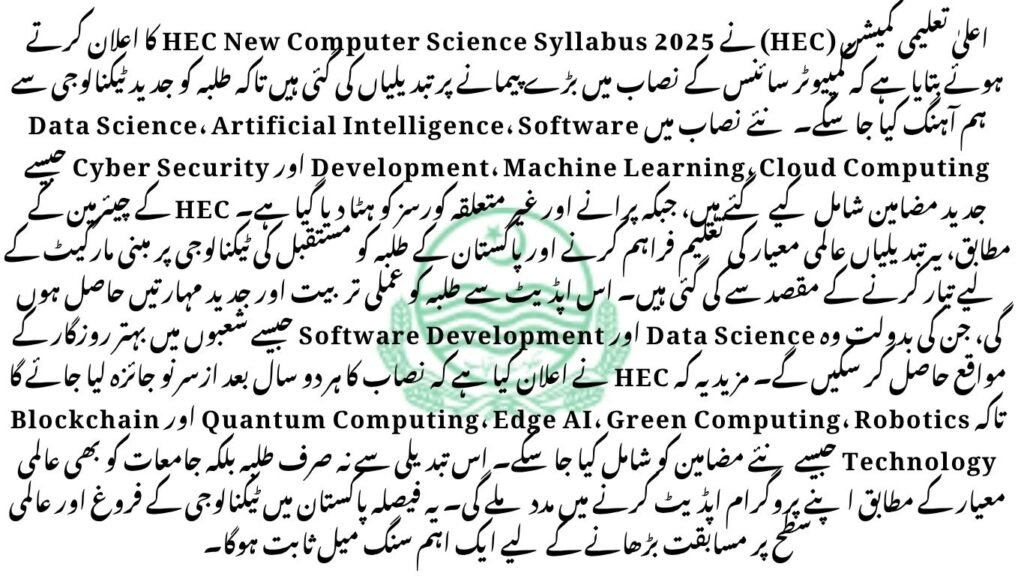
Major Highlights of the HEC Revised Computer Science Curriculum
The HEC curriculum review computer science brought massive updates. Below are the key highlights:
| Category | Major Updates in the New Syllabus |
|---|---|
| Core Courses | Updated programming languages (Python, JavaScript, Kotlin), new data structures, and algorithm modules |
| Emerging Technologies | Inclusion of AI, Data Science, Cloud Computing, and Internet of Things (IoT) |
| Cybersecurity | Dedicated courses on network security, ethical hacking, and data protection |
| Practical Focus | Increased lab work and project-based learning |
| Industry Linkage | Internship programs with tech companies made compulsory |
| Specializations | New tracks in AI, Robotics, FinTech, and Blockchain |
| Research Integration | Undergraduate research projects introduced in the final year |
This table summarizes how the HEC computer science syllabus 2025 will help students build real-world skills instead of just focusing on outdated theoretical knowledge.
Why the Change? – The Need for an Updated Curriculum
In today’s world, where Artificial Intelligence (AI), Cloud Computing, and Cybersecurity are rapidly transforming industries, Pakistan’s higher education needed a strong revamp. HEC recognized that the previous syllabus was outdated and didn’t meet modern market demands.
The new CS syllabus Pakistan focuses on practical implementation, industry-driven projects, and hands-on coding experience. It ensures that students not only understand theory but can also apply it in real-world scenarios.
According to HEC officials, this curriculum reform was developed after consulting leading universities, IT professionals, and software houses across Pakistan.
Core Structure of the New CS Curriculum
HEC’s industry-aligned CS curriculum is divided into three main parts:
- Foundation Courses – Mathematics, Programming, and Computing Fundamentals.
- Core Courses – Data Structures, Operating Systems, Database Systems, and Web Development.
- Advanced & Specialized Courses – Artificial Intelligence, Machine Learning, Cybersecurity, Cloud Computing, and Data Analytics.
This step ensures that every Computer Science student develops both theoretical understanding and practical expertise throughout their degree.
New Specializations Introduced by HEC
The most exciting feature of the HEC new computer science syllabus is the introduction of multiple specialization areas.
- Artificial Intelligence (AI): Students will learn about neural networks, machine learning algorithms, and real-world AI applications.
- Cybersecurity: A dedicated track focused on protecting networks, data, and systems from threats.
- FinTech & Blockchain: Introducing financial technology and decentralized systems to align with digital finance.
- Cloud & DevOps: Emphasizing scalable systems, automation, and server management using cloud platforms like AWS and Azure.
- Robotics: Combining hardware programming with intelligent automation for future innovations.
These specializations aim to produce industry-ready graduates capable of contributing to Pakistan’s digital economy.
Collaboration with Industry Experts
One of the biggest breakthroughs in the HEC syllabus changes CS is the involvement of the private tech sector. HEC collaborated with software houses, startups, and IT industry associations such as P@SHA and NASTP (National Aerospace Science and Technology Park).
This collaboration ensures the syllabus remains future-proof and aligned with the needs of the local and international job markets. According to HEC officials, the revised computer science curriculum will be reviewed every two years to stay updated with new technologies.
Implementation Timeline
The new computer science course update will officially be implemented in all public and private universities across Pakistan starting from the Spring Semester 2026. Universities have been instructed to:
- Prepare new course outlines.
- Train faculty according to the revised curriculum.
- Upgrade computer labs with new tools and software.
HEC also plans to launch training sessions and webinars for teachers to help them understand and deliver the new syllabus effectively.
How Will This Benefit Students?
The HEC New Computer Science Syllabus 2025 brings countless benefits for students:
- Practical Learning Environment: More coding labs, project-based learning, and group work.
- Job Market Alignment: Courses designed around the most in-demand tech skills.
- Research Opportunities: Students will now complete research projects even at the undergraduate level.
- Global Compatibility: Pakistani graduates will have skills comparable to international standards.
- Career Flexibility: Students can choose between research, entrepreneurship, or industry jobs after graduation.
This reform directly supports Pakistan’s vision for a digital future, helping young professionals compete globally.
University Readiness – What Institutions Need to Do
Universities across Punjab, Sindh, KP, and Balochistan have been advised to adopt the HEC revised computer science curriculum by early 2026. They must also ensure their faculty training programs align with new technologies like AI, Cloud, and Cybersecurity.
HEC emphasized that universities will be monitored for compliance, and accreditation will depend on adopting the latest syllabus. This ensures equal standards nationwide.
Expert Opinions on the New CS Curriculum
Educationists and IT industry experts have praised the HEC curriculum reform in computing. According to them, the new structure will finally end the “theory-only” mindset in Pakistani universities.
One expert from NUST stated:
“This is the first time Pakistan’s CS curriculum matches global trends like AI, data science, and blockchain. It’s a big step toward producing globally competitive graduates.”
Future Plans – Continuous Improvement by HEC
HEC has also announced that the HEC New Computer Science Syllabus will be reviewed biennially (every two years) to stay aligned with the world’s rapidly evolving technology landscape. Future updates are expected to introduce Quantum Computing, Edge AI, Green Computing, Blockchain Development, Data Science Development, Cloud Security, DevOps Automation, Cyber Forensics, and immersive technologies like Augmented Reality (AR) and Virtual Reality (VR). These upcoming inclusions aim to make Pakistani Computer Science graduates globally competitive, enabling them to master next-generation digital skills demanded by the international tech industry.
This initiative reflects HEC’s long-term commitment to making Pakistan’s Computer Science education globally competitive.
Conclusion
The HEC New Computer Science Syllabus 2025 marks a revolutionary change in Pakistan’s education system. By aligning academia with real-world industry needs, this initiative will produce skilled, innovative, and globally competent graduates ready for tomorrow’s digital challenges. This reform not only modernizes education but also sets a new standard for how universities in Pakistan will shape the next generation of computer scientists and tech innovators.
Frequently Asked Questions
Q1: What is the HEC New Computer Science Syllabus 2025?
The HEC New Computer Science Syllabus 2025 is a modern, industry-aligned curriculum designed to include emerging technologies like AI, Data Science, and Cybersecurity for Pakistani universities.
Q2: When will the new CS syllabus be implemented in universities?
The implementation is expected from the Spring Semester 2026 in all public and private universities across Pakistan.
Q3: What are the major changes in the revised computer science curriculum?
Key changes include new programming languages, AI and Data Science modules, increased practical work, mandatory internships, and specialization tracks.
Q4: Who developed the new HEC computer science curriculum?
It was developed by HEC in collaboration with IT experts, top universities, and Pakistan’s software industry representatives.
Q5: Will the new syllabus affect ongoing students?
No, the new syllabus will apply to new admissions from 2026 onward, while current students will continue under the old scheme.